EuroCv: the story of a European curriculum born in 2005
Born in Trieste in 2005, EuroCv offered free online CVs in 25 languages, translated by volunteers across Europe. A Global Junior Challenge finalist, with public APIs and personal subdomains, it stayed in service until May 2026. Today eurocv.eu and eurocv.it point to this page: the story of the project, and what remains of it.


EuroCv was our first project built for the whole world: a free online curriculum vitae in twenty-five languages, born in Trieste in 2005 and kept in service until May 2026. Today the domains eurocv.eu and eurocv.it both lead here, to this page. This is its story — and why it is worth telling.
November 2005: a simple, almost naive idea
The first project note is dated 23 November 2005, 4:27 pm. It describes something utterly mundane: put a little help icon next to every field in the form, because filling in an online CV should not be torture.
A hundred more notes grew out of that one. A barcode to print on the paper CV. A world map of profile visits. Export to Word, to plain text, even to LaTeX. T-shirts for the staff. A public directory to browse CVs by industry. The core idea, though, never changed, and it was written in two lines on the homepage of the day:
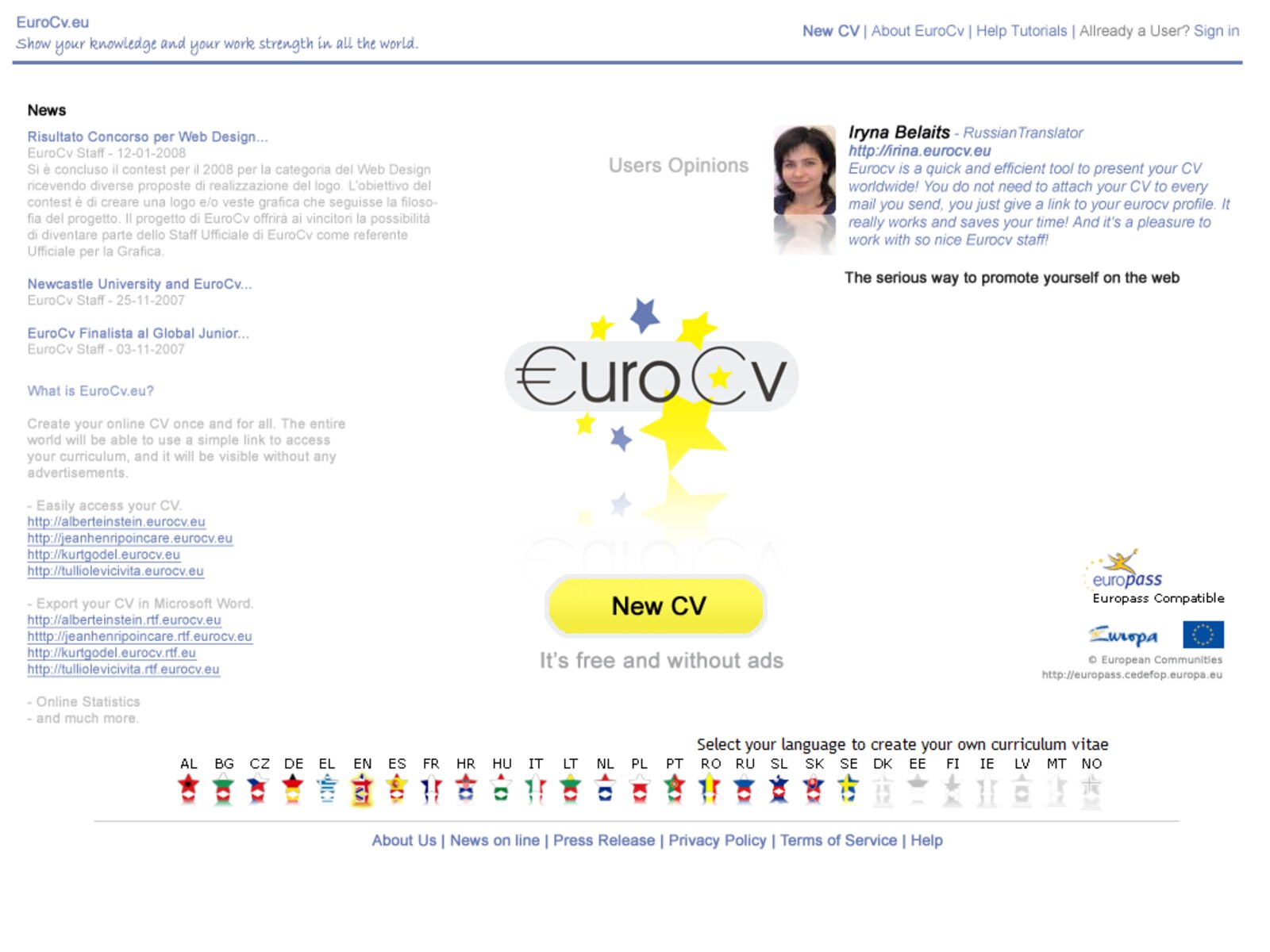
Create your online CV once and for all. The entire world will be able to use a simple link to access your curriculum, and it will be visible without any advertisements.
That link was the part people loved most. Everyone had their own personal subdomain — firstnamelastname.eurocv.eu — and no longer had to attach a PDF to every email. Add .rtf to the address and the same CV came out ready for Microsoft Word. In 2006, that felt like a small piece of magic.
Twenty-five languages, translated by strangers
The most ambitious part was not the CV itself: it was the translation. EuroCv had to work in twenty-five European languages, and we had no budget for agencies. So we built our own system — it was called EuroCv Internationalization — where anyone could register as a translator or reviewer, claim a sentence, translate it and send it on for review.
There was a leaderboard of the most active translators and an official certificate for contributors. Today we would call it crowdsourcing and write a business plan around it. Back then it was simply the only way we knew to get from Albanian to Norwegian without money.
It worked. People we never met in person, scattered across Europe, translated a free service because it struck them as the right thing to do.

The world map
One of the features users loved most was the access statistics for their own CV. Not a counter: a map of the world with a red dot for every city where someone had opened your CV.
The image below is the real map of a CV hosted on EuroCv in 2008. Every square is a person who, somewhere out there, opened that page.
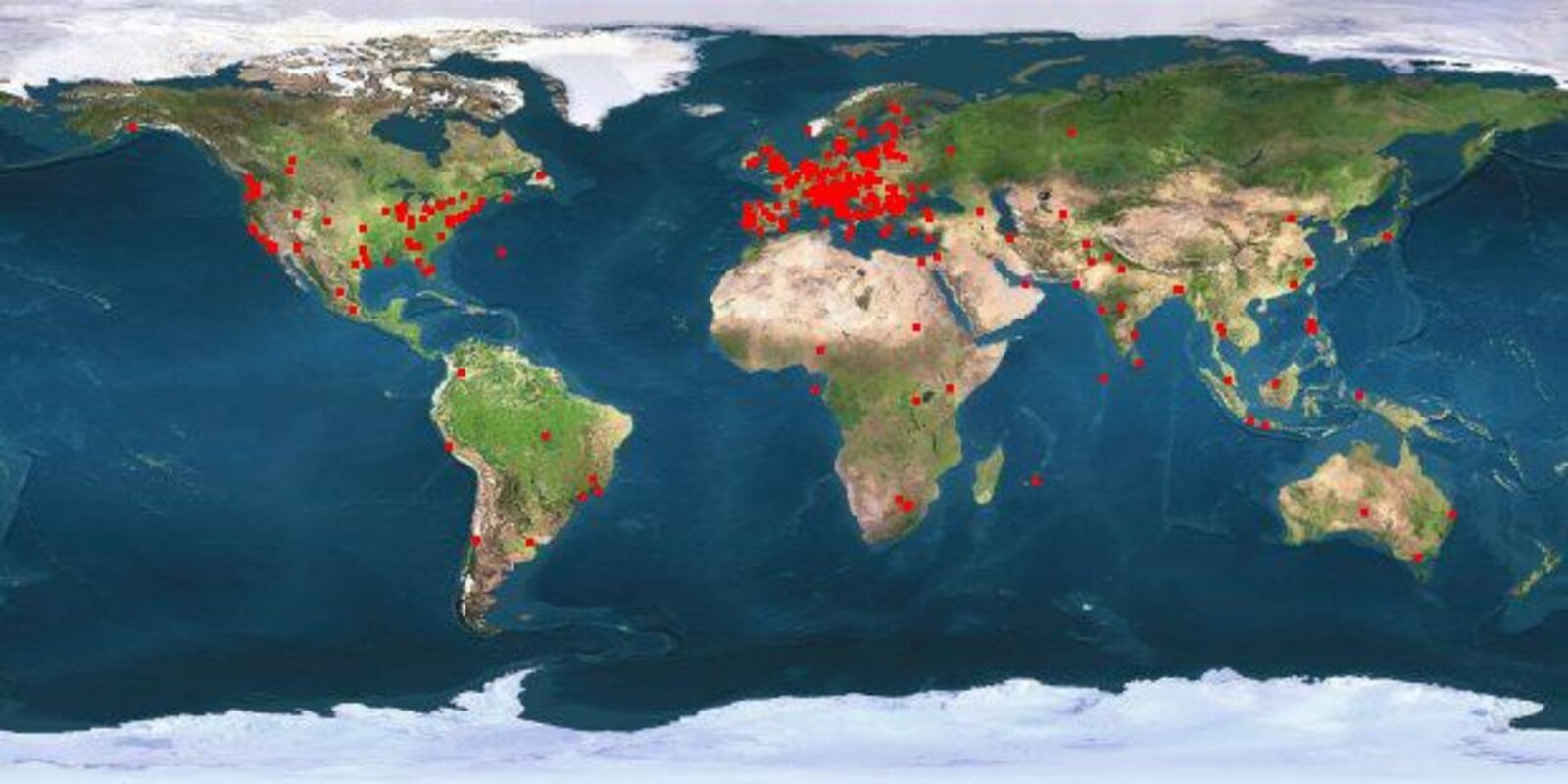
Seeing that map for the first time was the moment we understood this had become serious. We were no longer building a website: we were handling the professional identity of real people, in places we could not have pointed to on an atlas.
The good years
Between 2007 and 2008 EuroCv had its rewards. It became a finalist at the Global Junior Challenge, the international award held in Rome for technological innovation with social impact. Newcastle University came knocking. The Friuli Venezia Giulia Region looked at it for career guidance, and a draft memorandum of understanding with universities was drawn up. We even ran a public contest for the animated logo, open to anyone: the winner joined the official staff.
On the technical side there is one thing we are still proud of: EuroCv exposed public APIs, with ready-made client libraries in Java, PHP, Python, VB.NET, Flash and SOAP. In 2008. Anyone could take the data from a CV and carry it elsewhere — because that data belonged to the person, not to us.
Then the world changed its mind
There is no precise moment when EuroCv ended. There is a slow change in the wind.
LinkedIn arrives and the CV stops being a document you write: it becomes a profile you update. Social networks arrive and the professional network matters more than the well-formatted page. The big platforms bring resources a software house in Trieste cannot even imagine. And above all, the question the CV answered changes: no longer «what have you done», but «what can you actually do, and who vouches for it».
EuroCv, however, did not stop. It kept being developed, updated and maintained online — servers, upkeep, an evolving codebase — until May 2026. Twenty years of uninterrupted service.
It is worth saying how it really worked, because this is the part we are proudest of: EuroCv never had a business model. No advertising, no subscriptions, no external funding. It was always a volunteer project, funded entirely by Shine Software: we put in the work and the costs, the translators put in the languages, and the service stayed free for everyone.
You can only keep something like that alive for twenty years if you believe in it.
The real reason it closed: the data
If we had to name a single reason why EuroCv could not continue, it would not be LinkedIn. It would be this: in the meantime, the very meaning of personal data changed.
In 2005, publishing your CV at a public web address was seen as pure progress. That was precisely the service: an open link, reachable by anyone, anywhere in the world, with no barriers. Name, surname, date of birth, address, phone number, email, education, complete employment history, often a photograph. All of it accessible to anyone who knew the address. Nobody saw a problem with that at the time: it was the whole point.
Today that same list reads very differently. It is the perfect profile for identity theft, ideal raw material for a tailor-made scam, the starting point for targeted phishing or a fake job offer. And it no longer takes a human visitor: automated scrapers harvest any public content and resell it in aggregate, or pour it into the datasets used to train artificial intelligence systems. A CV published in good faith in 2008 may have been copied a thousand times into places nobody controls any more.
The GDPR, since 2018, put that shift in sensibility into law. Data minimisation, a legal basis for every processing activity, granular and revocable consent, retention limits, the right to erasure and to be forgotten, portability, breach notification, impact assessments. These are fair rules, and for the most part they describe things we simply did not think about in 2005.
The point is that a service like EuroCv cannot be brought into line with a few tweaks today. It would have to be rebuilt from scratch on a philosophy opposite to the one it was born with: profiles private by default, indexing blocked, active anti-scraping defences, encryption at rest, automatic deletion of dormant profiles, records of processing activities, incident response procedures, a data protection officer. All legitimate and necessary — but that is a different product, with costs and legal liabilities a volunteer project cannot carry.
The truth is simple: the idea of a free and open platform, where data is shared without friction because sharing is a good in itself, belongs to another era of the internet. Not because the idea was wrong, but because the world around it became more predatory than we imagined.
That is why we chose to close rather than let things drift. Keeping online a service that holds the personal data of real people, without being able to guarantee the level of protection those people now have every right to expect, would have been irresponsible. Over its lifetime EuroCv helped tens of thousands of people present themselves and look for work: it was right that it should end by protecting them, not exposing them.
In the end the project closed the way almost everything closes: with no announcement and no ceremony. But that decision, at least, was made with our eyes open.

What remains of EuroCv
What remains is an intuition that time has vindicated rather than dismissed. EuroCv said three things back in 2005: professional data belongs to the person; it should be reachable through a link, not attached to an email; it should cross the languages and borders of Europe.
Those are exactly the principles the European Union is building its digital credentials on today: diplomas and certificates signed electronically, held by the person in their own digital wallet, verifiable in an instant by any employer, in any member state. The self-declared CV gives way to demonstrable skill.
We were right about the problem. We were just twenty years early on the tools.
Why this domain leads here
The domains eurocv.eu and eurocv.it will not be renewed: once they expire they will be retired, along with the personal subdomains where the CVs used to live. Switching the service back on is not an option, for the reasons set out above.
For as long as those addresses exist, though, they all lead here — including the old addresses of the individual CVs. Anyone arriving from a fifteen-year-old link does not hit an error page, but the story of what that link belonged to. It is the most honest way we know to close something down: walking the project to the door, rather than pulling the plug and leaving.
EuroCv was designed and developed by Shine Software in Trieste from 2005 onwards, and stayed online serving its users until May 2026, with the help of dozens of volunteer translators across Europe. To all of them, thank you.
Founder di Shine Software. Da oltre 12 anni progetta e sviluppa e-commerce Magento con AI integrata, hosting gestito e soluzioni su misura per le PMI italiane ed estere.