GEO: how to get your Magento store found by ChatGPT, Claude and Perplexity
Shoppers increasingly ask AI assistants instead of Google. What Generative Engine Optimization is, how AI crawlers read your site, what llms.txt is and what to do on Magento 2 to be cited in AI answers.

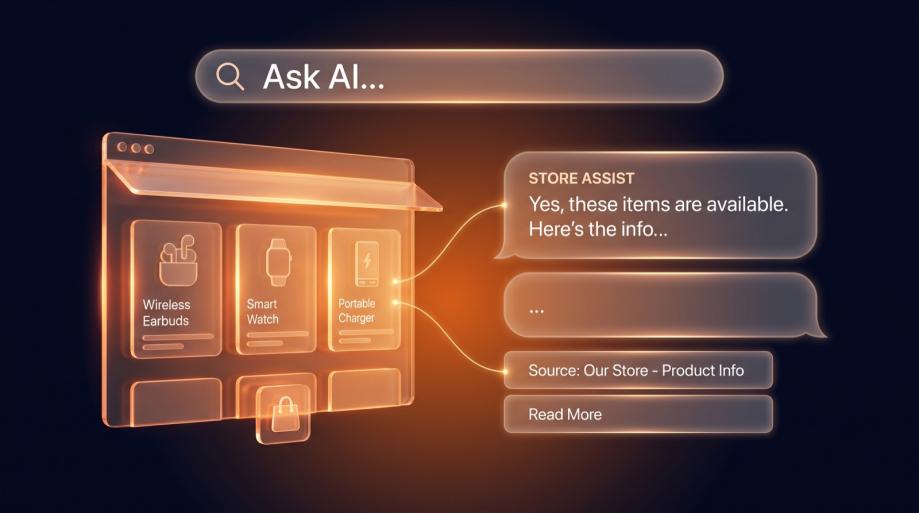
Until recently there was only one question: how do I rank first on Google? Today a growing share of shoppers skip the results page and ask ChatGPT, Claude, Perplexity, Gemini or Copilot directly: "what is the best GDPR module for Magento?", "where can I buy a spare part for my coffee machine?". The assistant reads the web, picks a few sources and answers by citing them. If your store is not among those sources, for that shopper it simply does not exist.
This new field is called GEO – Generative Engine Optimization: the practices that make a website understandable, trustworthy and citable by AI-powered answer engines. In this article we look at what has changed, how AI crawlers work and what you can actually do on a Magento 2 store.
What has changed in search
Traditional search returns ten links and leaves the comparison to the user. Generative search does that work for them: it reads, summarises, compares and proposes a ready-made answer, often with two or three links as sources. For online merchants this has three consequences:
- Fewer clicks, better qualified. Visitors coming from an AI answer have already compared the alternatives and are often ready to buy.
- Being cited beats ranking. Being tenth or first matters less than being one of the sources the model chooses.
- Clear content wins. Models reward pages with explicit, verifiable information: what you sell, at what price, for whom, with which features.
How AI assistants read your site
Behind every assistant there are several crawlers with different purposes. It is important to tell them apart, because they should not all be treated the same way:
- Training crawlers (e.g.
GPTBot,CCBot,Google-Extended): collect content to train future models. You can choose to opt out without losing visibility in answers. - Search crawlers (e.g.
OAI-SearchBot,Claude-SearchBot,PerplexityBot): index the web for real-time answers. Blocking them means disappearing from citations. - User-triggered agents (e.g.
ChatGPT-User,Claude-User): visit a page when a user explicitly asks to read it.
The problem is that many of these bots do not execute JavaScript, have a limited reading budget and must interpret pages full of menus, widgets, pop-ups and tracking code. A Magento product page, read "raw", carries a lot of noise and little signal.
llms.txt: a site map designed for AI
To solve this, the llms.txt proposal was born (llmstxt.org): a Markdown file published at the site root, like robots.txt, that presents the site in a clean way. It contains the name, a short summary and a list of links to the important pages, each with a description. The llms-full.txt variant also includes the full text of the pages, already stripped of HTML.
The benefit is obvious: instead of downloading and parsing hundreds of pages, an assistant finds a structured summary of your catalog in a single file. It is the same idea as the XML sitemap, but written for those who read the text rather than follow the links.
How to make Magento 2 readable by AI engines
GEO does not replace SEO: it extends it. These are the actions we recommend to our clients, in order of impact:
- Decide who may read your site. Review
robots.txt: allow search and answer crawlers, consider opting out of training-only bots. Check your WAF and CDN too, which often block AI bots without you knowing. - Publish llms.txt and llms-full.txt for every store view, with categories, products, information pages and blog posts, in the right language.
- Take care of structured data. Complete schema.org
Product,Offer,Review,OrganizationandBreadcrumbListmarkup, consistent with what the page shows. - Write descriptions that answer questions. Who the product is for, what problem it solves, what it is compatible with, what it includes. Avoid supplier copy: models reward original information.
- Make commercial information explicit. Prices, shipping, returns, warranty and contacts on clear text pages, not only in images or pop-ups.
- Keep the site fast and the server reachable. A crawler that gets errors or timeouts moves on to the next source.
- Build authority. Signed blog content, real case studies, verified reviews: assistants prefer recognisable sources.
Shine GEO: GEO ready for Magento 2
We turned the first two points into an extension. Shine GEO automatically generates /llms.txt and /llms-full.txt for every store view (including URLs such as /it/llms.txt and /en/llms.txt), covering CMS pages, categories, products with price and Mageplaza blog posts. From the Magento admin you can write the store summary, exclude pages, set limits and choose which AI crawlers to block in robots.txt, which will also tell bots where to find your llms.txt.
Files are cached and rebuilt when the configuration is saved: no performance impact, no external service, no subscription. We use it ourselves on this very site.
Bring your store into AI answers
Discover Shine GEO for Magento 2: it installs in minutes and, if you wish, we take care of configuration, testing and production release. Wondering how AI assistants read your architecture? Let's talk.
Founder di Shine Software. Da oltre 12 anni progetta e sviluppa e-commerce Magento con AI integrata, hosting gestito e soluzioni su misura per le PMI italiane ed estere.